

Anime Recommendation: Slayers
Fantasy Games: The Anime

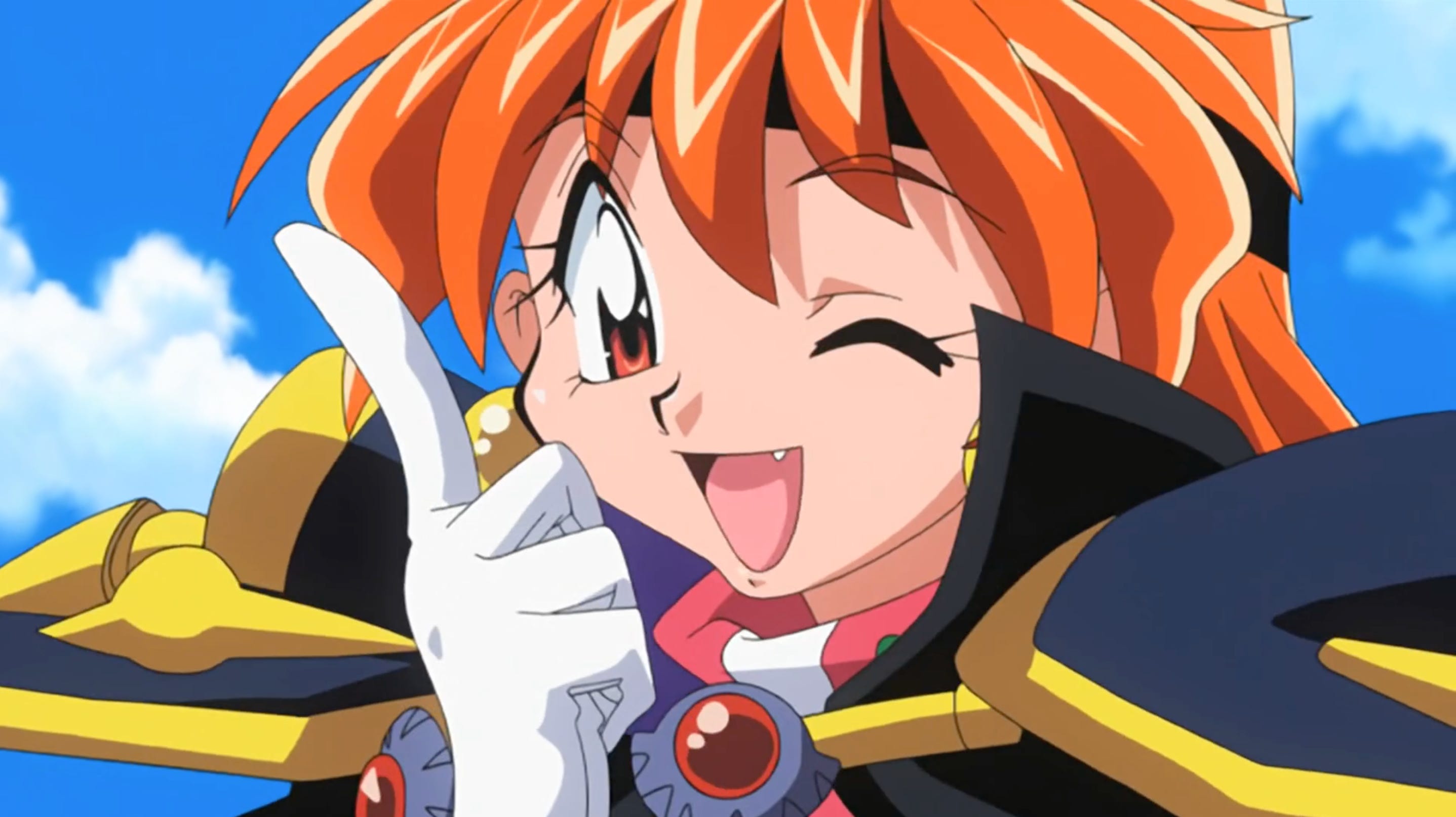
[This post is adapted, with adjustments for flow, from a post originally written on realmgard.com]
You may be wondering what I watch when I'm not writing. Well, how about a pretty logical follow-up to my previous recommendation post about Dragon’s Crown?
Whereas I described Dragon’s Crown as ‘Fantasy Games: The Game,’ Slayers could just as easily be summed up as ‘Fantasy Games: The Anime.’
There's a saying among certain segments of the Internet — specifically, TV Tropes — that:
Lodoss War is the DnD campaign we all dream of playing. Slayers is the DnD campaign we actually end up playing.
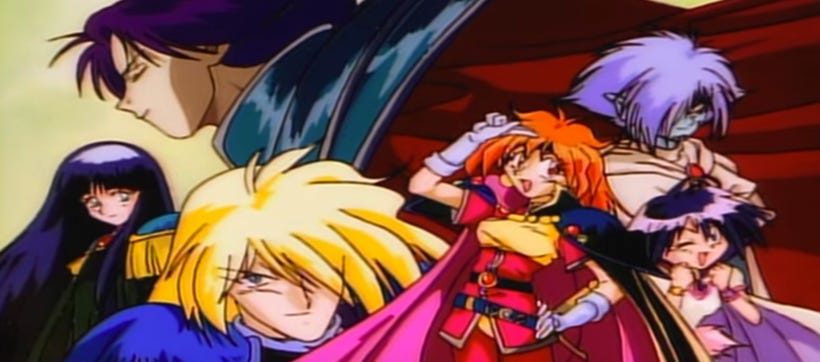
And, yeah, that about sums it up. Although both works are both quintessentially Fantasy-y in terms of worldbuilding, character archetypes, and plot beats. But whereas Lodoss War (while not devoid of humour) is a self-serious, unironic "Save the World" High Fantasy story, Slayers is a silly show featuring a cast of complete lunatics alleged heroes doing their best, darn it who occasionally buckle down to save the world from the forces of Evil in climactic final showdowns that are generally presented seriously and unironically.
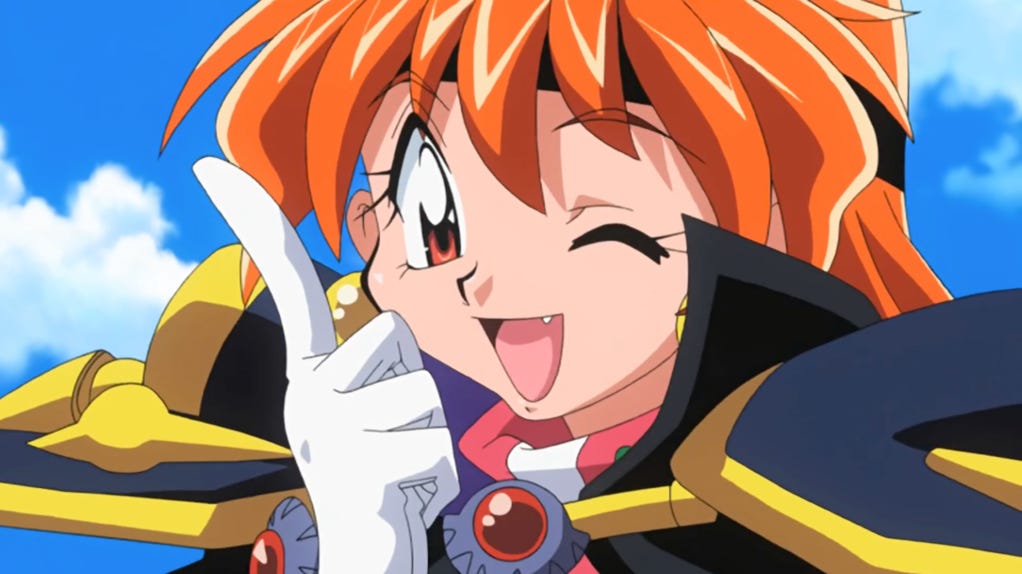
We have Lina, a young sorceress who tends to solve her problems by blowing them up, Gourry, a swordsman with an IQ of approximately -12, Zelgadis, the serious one, and Amelia, a princess whose boundless desires above all to be a great hero of justice is matched only by her general ineptitude.
But, like I said, they're doing their best, darn it.
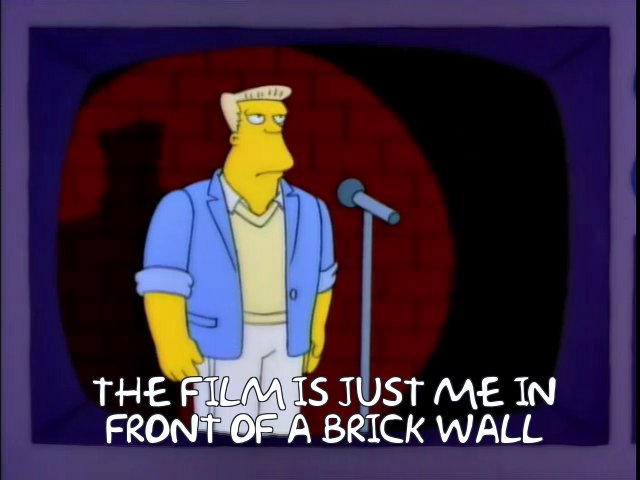
The characters have such bombastic personalities that the show would still be funny if it were just them standing in front of a brick wall every episode, but the humour of their personalities is magnified by the fact that such over-the-top personalities are constantly interacting with each other.
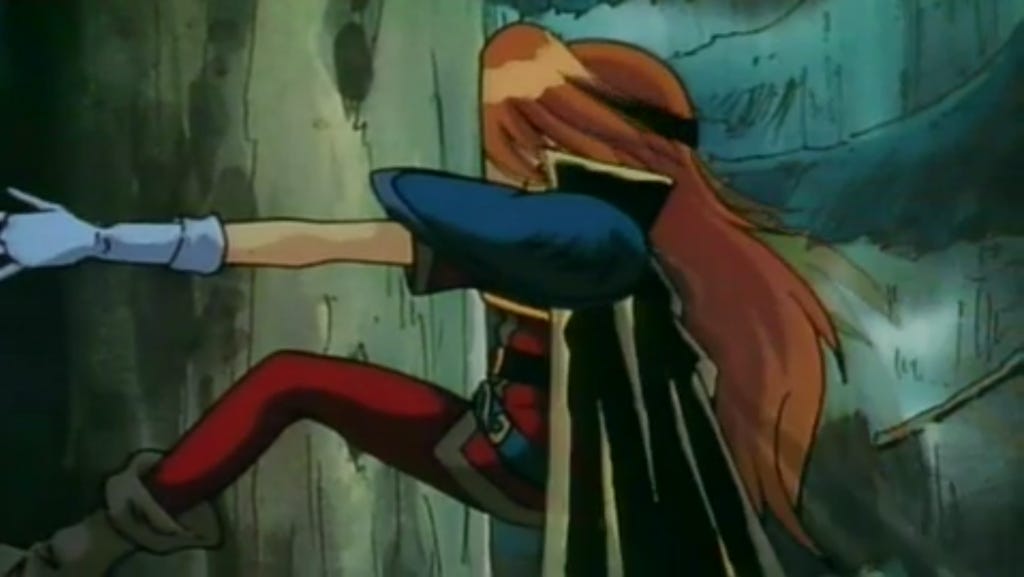
If I had to eyeball a rough estimate, I'd say Slayers is 70:30, "Silly" to "Serious." For the most part, whenever the characters are getting hurt, it's in a slapstick, very Looney Tunes-esque fashion — centring around the characters hurting themselves in novel ways (see above).
That being said, the boss fights, so to speak, against the major and usually genuinely-threatening bad guys to significantly up the stakes and drama. Characters (albeit usually minor ones) do die and at its most intense, the violence is about on par with Lodoss War, though that's the exception rather than the rule.
It's more serious than Rune Soldier, but rarely ever as serious as Lodoss War.
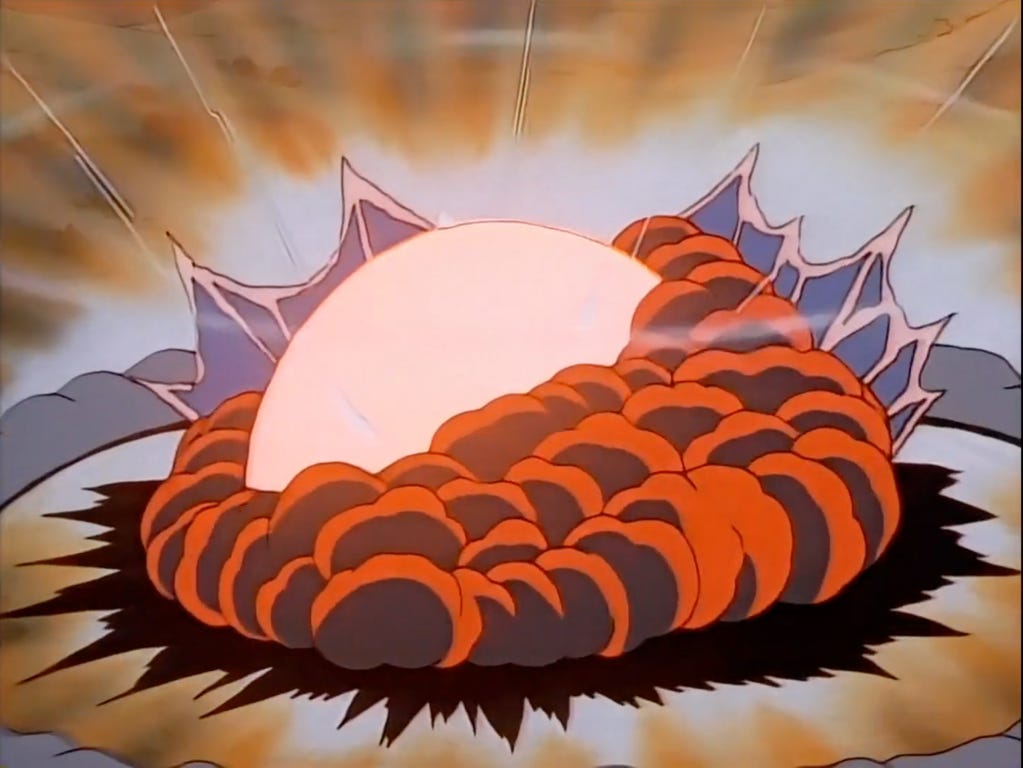
One of the running gags in the series is Lina's reputation for causing more problems than whatever the problem is she's initially trying to solve. A lot of this arises from the fact that her go-to solution is to blow up the problem with Dragon Slave, established to be among the most powerful destructive spells in the Slayers universe.
If, for example, she's fighting to prevent the bad guys from reducing the village to a smoking crater, the inevitable outcome is that she will reduce both the bad guys and the village to a smoking crater.
Basically, when all you have is a Dragon Slave, everything starts to look like a Dragon...
In the earliest versions of this post on the Realmgard blog, I mentioned that Slayers was originally a series of light novels, and that those light novels weren’t easily available in English.
That has since changed. Publisher J-Novel Club has released English translations of the original Slayers light novels in a series of 3 volume-in-1 compilations.
In brief, light novels are a Japanese form of book. Now, that's not to say they don't necessarily exist outside of Japan, it's just that they're generally called something else.
Basically, they're usually aimed at a YA audience, they've got numerous illustrations inside, and they're written in a light (hence the name), conversational style of prose, they're generally pretty short (they'd probably be considered and called novellas outside Japan), and they're written to be read and published in serial — Wikipedia says they've got about a 3-9 month publication schedule.
For what it's worth, plenty of popular animes have begun life as a light novel series: Haruhi Suzumiya, Lodoss (itself based on the author's DnD campaign) and Grancrest War (both by the same author), Dirty Pair (FYI, ‘dirty’ in this context means more ‘stigmatised’ than ‘sexy’), Bodacious Space Pirates, and so on.
All in all, Realmgard isn't really that far removed from a light novel series — with the notable exception that Realmgard doesn't have any interior illustrations.
In terms of differences between the anime and the light novels, the anime followed the plot of the novels until the third season of the anime, subtitled TRY — although the creator Hajime Kanzaka was involved in the production (FYI: he doesn't like that season).
Up to that point, the differences are fairly minor and can largely be chalked up to the differences in medium. The novels, for example, are told from Lina's POV, so we see a lot of more internal monologue, whereas in the anime, she really only comments directly on the "Last Episode" and "Next Episode" summaries.
There's actually sort of a running dialogue from Lina directed at the reader, full of snarky and/or self-aggrandising little asides and comments. Which, of course, is entirely in keeping with Lina's character.
Actually, reading through the novels for the first time, it really does feel pretty Realmgardesque. Slayers is a very good example of how to balance Funny with Adventure, but also does also do a lot of the same things I do when writing a funny Fantasy world: the narration is full of sarcastic observations, the dialogue feels modern and casual rather than Fantasy-y, and the paragraphs are all pretty short.
Basically, like Realmgard, it's not a comedy, but also not-not a comedy…
The violence is a bit more descriptive and some of the interior illustrations (specifically the ones dealing with zombies and monsters) are pretty unsettling, but I don't think there's anything that really raises the novels from out of the same age bracket as the anime, though there is some mature content that was massaged into being a little less incongruous and less, well, mature, in the anime.
It's not appropriate for kids, but anybody older than, like, middle school isn't going to be traumatised.
And, like, it may be mature enough to feel out of character in the overall pretty lighthearted story. But obligatory reminder that the first season of Sailor Moon ended with literally all of the Sailors being brutally murdered…
Superficially, some of the translations of the names are different between the anime and the novels: for example, "Seyruun" vs. "Saillune" – and , incidentally, when it actually appears in writing on maps in the anime, it's "Seiloon." And, overall, the dialogue in the novels seems more stilted and directly-translated from the original Japanese than in the anime.
Notably, the novels recognise that "orichalcum" is a real thing (or at least a real mythological thing) and accurately translate it into English as "orichalcum", whereas the anime gets tripped up by the Ancient Greek-to-Japanese-to-English translation process and make it "orihalcon."
Which, admittedly, does sound pretty cool.
It was interesting to be able to read the novels for the first time after having become familiar with the show. One isn't necessarily better than the other — the anime is more Silly-Funny and the novels are more Clever-Funny, but the overall story is pretty much the same.
And there's probably enough additional violence and mature content in the novels for some people to find off-putting, but both the novels and the anime are worth your time, especially because the anime has several seasons' worth of storyline that aren't covered by the novels.
Again, not necessarily better, but at least more and I've enjoyed Slayers enough that more is a good thing.
Circling back to the anime, the series originally ran for three seasons (Slayers, Next, and Try) in the mid-to-late 90s. The originally planned fourth season fell through, but there was a two-season revival in the late 2000s (Revolution and Evolution-R). The seasons were progressively less well-received, possibly because of Kanzaka not being involved in the later series.
Though the revival does have the benefit of 10 years' worth of improvements to animation techniques.
The light novels ran 1990 to 2000 for fifteen volumes. Kanzaka started with new stories in 2018, from what I can tell looking them up, the entire series is now available in English
There's also a series of standalone OVA movies that were licensed and released in North America, but I'm not sure where it's possible to watch them — given that they were licensed by ADV which has since gone out of business and ADV's successor Sentai Filmworks does not appear to have picked up the rights.
Unfortunately, since Funimation was rolled into Crunchyroll and the series wasn’t brought over to Crunchyroll, the steraming situation for Slayers has been a bit of a mess. At least in Canada, it doesn’t seem available on any streaming service, though several of the seasons are available for digital purchase through platforms like YouTube and Prime, though even then, it doesn’t seem like there’s any one platform that has the entire series available…
Once again, if you enjoyed this post and are interested in more of my stories, author blogging, and Pop Culture critiques like this, please consider subscribing to the Emona Literary Services™ Substack:
This work is licensed under a Creative Commons Attribution-NonCommercial-NoDerivatives 4.0 International License.
